Monday, September 19, 2022

Political Space – Stories of A

No points for guessing on which side of the debate Serge Daney stood. This article was published in Cahiers du cinéma in December 1974 - January 1975, at the time when abortion was being legalised in France. To read more by Daney on militant cinema, read his intro to the chapter of La Rampe where the text below featured.


Political Space – Stories of A  

1. An updated title of Stories of A* could be Stories of Stories of A since the film itself also has a story. A well-known one: banned, distributed through first militant and then commercial means. An “audience” had to come into being, pitching in money and protecting its existence, simply for the film to be seen and debated. For the first time in a while, a film has managed to organise its audience. In this sense, Stories of A is truly an organising film, not because it disseminates theories developed elsewhere by and within political organisations but because its vision, its appropriation have created organisational problems: operating illegally, and (sometimes violent) confrontations. Stories of A allows us to ask a question at the heart of any film project: the space of the film screening as a space of conflict, a space to be conquered, almost a military space.  

Or: under what conditions can one go from one audience – one that is conditioned, organised for film consumption, guided by the usherettes and stuffed with ice cream – to another, one that knows that a film engaged in a struggle, like an idea, doesn’t come out of nowhere? For all the militants, all those that have distributed Stories of A, have had to take hold not only of a cause they already supported (that it is morally just to fight for the right to abortion) but also a form: the film-object, one that is breakable, stealable, perishable, expensive. The propagation of this object, the fight for its distribution, have not only popularised the ideas of the MLAC **, it has also taught two or three new things to its amateur distributors: a film, under certain conditions, can also function as an “organising force.”  

2. Yet, for many who have seen, defended or distributed the film, just as much as it is the case for those who have despised it and banned it (from François Maurin to Maurice Druon), Stories of A seems to draw its organising power only from the fact that it was banned. And it was seen to be banned solely because it addressed a taboo: abortion. In other words, for all of them, the film is merely a pretext.  

This not-so-new idea is the cross that “militant” cinema bears. It comes down to seeing a piece of art as a neutral object, a channel to popularise ideas developed elsewhere, with no other depth. Following this logic, a film only has to enable a debate, or speaking opportunities for militants seeking to advance their cause and transmit their message, in order to fulfil its mission, its entire mission. A film is to debate what an introductory short film is to the main feature: a preparation, a foretaste, a teaser. The film here is seen as the Trojan horse that smuggles the debate through. How many times have we heard this fateful phrase: “the film doesn’t matter in itself, it only exists to spark the debate”? How can one be surprised, then, with the eternal poor quality of militant cinema? 

To accept this conception means – for the distributors, the audience and the filmmaker – to use the film like a lure to attract audiences, even at the risk of losing this “captive” audience  in sad and dogmatic debates. It means normalising an instrumentalist conception of art. Instrumentalist meaning moments, mediums or reflections that are (or conceived as) neutral. An inevitable consequence: filmmakers are only called upon for their know-how (mastery of their specialty) and for their bad conscience (non-mastery of the general, i.e., political). They rapidly become service providers. But what if filmmakers “commissioned” in that way don’t consider their work and know-how as neutral? Who will they be accountable to for this non-neutrality? Where will they go to open up this other debate, the one around their work and the form of this work?   

3. This is why one must do what no one has thought of doing: talk about the form of Stories of A. And what does François Maurin have to say in his review for L’Humanité (dated 23 October 1974)? “One would like to know the young woman as more than someone lying on the delivery table having an abortion with Karman’s technique. One would like to know her troubles, to hear her talk more fully about herself and her fate.” From this review, we can imagine the film Maurin is dreaming about: another film, other filming choices: the slice of life allowing the filmmaker and the audience to examine devastated actors and lamenting victims. But Stories of A is exactly the opposite: in the long scene that Maurin references, the young woman is not just “lying on the table,” we see her in turn speaking and “being spoken” acting and “be acted”. It is not just a surgical scoop. There is more.  

For the thesis of Belmont and Issartel’s film is not just that women have the right to abortion, it is that Karman’s technique is simple, without danger, and filmable. The thesis of the film is not only that “we are right in revolting”, it is also that “we are right in filming”. And this accomplishes the following: 

- By placing this scene at the start of the film, to make it a reference, a proof.  

- By filming the abortion, to break the law that prohibits abortion and its filmic reproduction, and to acknowledge in this double prohibition a power specific to the cinema.  

- The power to graft its own space – the space of fiction within the sphere of the camera – onto a “somewhat liberated” space. Liberated space: the relation between doctor and patient. Liberated space: the relation between the filmmaker and the filmed.  

Far from “committed” sociology (always dreadful), Belmont and Issartel assert the spectacle, the conquered spectacle of a new relation between the doctor and the young woman and between the young woman and her body. The spectacle of a fear that is ceasing to be. In that sense, the film is indeed a scoop, but not about the secrets or dark corners of bourgeois medicine or the bloody insides of an unknown body , but about another way to practice medicine, on another mise en scène of medical power.   

4. We continue to diametrically oppose mise en scène (fiction, re-enactment) and live broadcasting (events captured live). To the excesses of a fetishist mise en scène inherited via the cinephilia of Hollywood genres, we continue to oppose the merits of live action, spontaneity, experience, naturalism – everything that has been made possible by technical progress and which culminated in the “cinéma vérité” of the 1960s. This is a false opposition. In political (or even political-scientific) terms, we should say that the bourgeoisie not only has the monopoly over filmed images of reality, it also has – as a priority over any film – the monopoly over the mise en scène of this reality. A city, a film theatre or a clinic are already a form of mise en scène. They come with a pre-existing user manual for the time and space they define, with mandated movements, thresholds and prohibitions. At a push, it is this user manual that is political (inasmuch as it reinforces a certain power). Whether a filmmaker films this space “live” or “naturalises” it in a fiction doesn’t exonerate him from this first mise en scène, which is all the stronger that it remains unseen, that it precedes the filmmaker’s, and that it often conditions it. The opposite of mise en scène is not unrestrained live action but another mise en scène. The opposite of live action is not mise en scène but another live action. Other in a way that they imply a new perception, a new position (be it spatial, moral or political) of the one filming vis à vis what is filmed. 

The abortion in Gennevilliers gives us a glimpse of what such a position can be. Where nothing can be accomplished without interlacing a new live action (a “trusted” filmmaker) and a new mise en scène (bodies spoken, voices heard, rebellion expressed). This interlacing defines a possible cinematic “political space.”   

5. For the rebellion (that of women in this case) doesn’t only generate symptoms that ought to be translated within and through the global discourse of the revolution. A struggle is being spoken and advances in the great chaos of incoherent statements, parodies, cries, watchwords, disorderly beliefs and everything that defines collective enunciation. Respecting this enunciation has allowed Belmont and Issartel to avoid the pitfalls that are common currency in militant cinema and which entail using political knowledge (even and especially Marxism-Leninism) solely as a decrypting dogma, a machine to translate what is being spoken in a struggle.  

Shall we hand back to those fighting – along with the strategic meaning of their fight – the fervour, the inventiveness and the joy that also can be found in fighting? This is an unavoidable question for any cinema aiming to be militant. A question that obliges militant cinema to not be unequivocal, unilateral, uniform or monological. For, if a struggle is being spoken, it never says “I.”  

* The filmmaker, Charles Belmont, who was first an actor for Chabrol, had made The Froth of Time (1968) adapted from Boris Vian’s novel and Rak (1971). He would later make Pour Clémence.   

** Movement for the Freedom of Abortion and Birth Control [translator’s note]. 

First published in Cahiers du Cinéma, issue 254-255, Dec 1974 – Jan 1975. Reprinted in La Rampe, cahier critique 1972-1982, Cahiers du cinéma – Gallimard, 1983. Translation by Laurent Kretzschmar and Srikanth Srinivasan.

Tuesday, September 06, 2022

Hawks double bill: Rio Bravo / Rio Lobo

Howard Hawks holds a special place in Serge Daney's criticism. 

"Hawks was the guy who had made Rio Bravo, it was the first film I’d written about and it’s stayed an essential film all my life. It’s a film I could talk about for hours because that film has accompanied me. This was a film that looked at me, which saw me as I was, I, as a teen-ager, and which knew a lot about me, much more than I thought I knew about it. So Howard Hawks was for me my favorite film-maker." Serge Daney, Journey of a Cine-Son.

Daney's first ever review, of Rio Bravo, was called "An Adult Art", published in 1964 in the short-lived amateur film magazine he created with school friend Louis Skorecki (the issue also contained a text by Daney on Scarface). Daney and Skorecki went on to meet Howard Hawks during their US trip for Cahiers to interview "classical" filmmakers. And although Daney only wrote two other texts about Hawks, one of his most formidable was his review of Rio Lobo, published in 1971 in Cahiers du cinéma, "The One Grows Old" (Daney was 27). 

The significance of Hawks and these two films for Daney is complex and I refer you to both Silvie Pierre's text "Rio Daney Bravo" (Trafic, 37) and Bill Krohn's several references to it (calling the Rio Lobo review "a Bugs Bunny cartoon boinging onto the screen after one of Lacan's famous seminars" and "the best thing Serge ever wrote").

Since the newly published The Cinema House and the World includes Daney's "An Adult Art", it was the opportunity to finally translate "The One Grows Old" in order to make this double bill available. The translation was a collaborative effort with Andy Rector and Bill Krohn and I really can't thank them enough. Bill not only came up with the title many years ago (a film by, 2005) but helped us resolve many difficulties. Thanks also to the generosity of the team at Semiotext(e) for allowing us to reproduce Christine Pichini's translation of "An Adult Art".


The One Grows Old

(Howard Hawks and Rio Lobo)  

But the enjoyment of which the subject is thus deprived is transferred to the imaginary other who assumes it as the enjoyment of a spectacle: the spectacle offered by the subject in the cage where – with the participation of a few wild animals from the Real, usually obtained at their expense – he pursues his prowess in the exercises by which he proves that he is alive.   

Jacques Lacan 

What is age, the passage of time, if not what is written on faces? And what is more common in the films signed by Howard Hawks than the horror of that writing? Their watchword could be: no traces! And if there is a passage (from one thing, whatever it may be, to another), let it be by sleight of hand, not by writing.  

In 1932, Scarface, already the story of a scar and therefore of a tragedy, pointed to the problem. Today, with Rio Lobo, the story of a wound, the problem returns. In between, it has not ceased to stealthily haunt the work of Hawks whose vaunted worldview and morality can only be understood from the starting point of this phobia of traces and writing.  

Not writing doesn’t mean completely giving up articulating (a temptation that sometimes surfaces, for example in The Big Sky). It means not retaining anything from what passes, loving traces only as indices (in the way C. S. Pierce defines the term: “an index has the being of present experience”). Smoke and fire, blood, the beer and the assassin (Rio Bravo), the gaze and what is being looked at. The index is still the best mode of articulation because “presence” is only denied in it, “out of sight”, for an instant, ready to resurface at the end of a tracking shot or in a reverse shot, enriched by having been momentarily forgotten.    

Hence at least three consequences:  

a) The utility of the “little Hawksian world” and its mercenary morality, behind which we must understand this: the “Hawksian” character doesn’t need for things to be written to read them. For him, everything silently signals. Friendship between men is merely a practice common to photology and the Boy Scouts. In Rio Lobo, you still know how to orient yourself by checking which side of the trees moss grows on. What has never been written can, barely read, fall into oblivion without consequences.  

b) The radical impossibility of imagining any passage outside effacement and substitution. The dread that something survives passage, that a trace (a witness, something written, a wrinkle) remains. Effacement: literally in The Dawn Patrol as the names of the pilots not returning by the evening are simply erased from the blackboard. The relation to death – a passage if there ever was one – is always thought of in this way: a dead body is never death. Death is simply being absent, not being in one's place. More precisely being offscreen.  

Yet, the existence of dead bodies ensures that death and disappearance never quite coincide: the body is what remains, what “survives” passage. Remember Red Line 7000: to die is to leave the track, and therefore the screen.  

c) An obligation – that of the One (“the little Hawksian world”) to constantly replace itself at the moment when it risks becoming something really other, which we might also call old. Hence the tiresome streams of replacements who are nothing except for the place they occupy (we shall see which one). Hence the unavoidable hostage exchanges (in Rio Bravo) which realize the fantasy of the total equivalence of all the characters, each bearing the weight of the whole film for a moment. Hence, finally, intrinsically linked to the previous “how to get rid of dead bodies?”, the need, always more difficult to satisfy, for new flesh: Hawks as a discoverer of new actors and new faces.   

Such a summary, even hasty, is not surprising today (Hawks is a well-known, respected filmmaker). Let’s just go a little bit further: these images, these extras, these films infinitely replacing one another, the need for new flesh and the art of making dead bodies disappear, A [the Other] never passing to B but rather to A’, this stubborn flight standing still (which flight? Let’s be clear, there’s only the unsuccessful one at the beginning of Rio Lobo: in the train car, hermetically closed, with the gold), we can see in all of them the mark of the obsessional neurotic, if the obsessional neurotic is the one on the verge, at any moment, of losing his precious relationship to unity, of already no longer being quite the same, not so much because he would suddenly be missing from his place. but rather because he would have to accept himself as the bearer of something extra that is not an extra wrinkle or a paunch, which we must dare to name as the rot-resistant cadaver, like the unbreakable phallus which some (Serge Leclaire) say is also the copula, meaning the naked possibility of writing and losing oneself in the game of differment, assuming one has ever belonged to oneself outside one’s fantasy. That is the risk. So much so that Hawks and his characters will only preserve the truly hallucinated feeling of the One’s reality and the “mark of genius*,” by a double denial:  

1. The assumption of his own castration by the “hero”: being already the phallus, in no way can he also have it! The recurrence in H. H.’s films of scenes showing a parody of castration – a finger out of joint: A Girl in Every Port (1928), a cut finger: The Big Sky (1952), an arm in plaster: Man’s Favorite Sport (1963) – can be read as the urgency, in dangerous moments, of remembering and celebrating (discreetly of course) the origin and the reason for the hero's “election". Namely, self-mastery,** with the paradoxical consequence of always appearing subtly below one’s capabilities. “Can a one-armed man go to heaven?” wonders Edward G. Robinson in Tiger Shark (1932): he is reassured.  

2. The assumption of frame as castration, meaning as extraction and cutting out of the Real itself a space beyond which nothing exists but within which, in return, everything exists with the intensity and the “presence” of the part when it’s taken for the whole.  

We can see that, in both cases, one must first accept what will later be carefully hidden. “Unity” is nothing more than an effect of castration which, although imaginary, is no more decisive in founding both a conception of the cinema as a window cut into*** the world and of the hero as the one appearing in the frame of this window (and nowhere else).  

At this point, let’s agree that nothing forces critics (including this one) to be complicit in the obsessional quest for unity. Be it the unity of the work (la politique des auteurs), of the film, or more modestly of something like a discrete element. This is the obsessional criticism that more or less survives in the mainstream press and is centered on a principle that we could, according to Jean Narboni’s famous expression, formulate in this way: a film exists, I have seen it.   

Let’s return to Rio Lobo. The beginning of the film is a tragedy: Wayne entrusts a mission to his “son”: to barricade himself inside the wagon to protect the gold. We can find here the very simple relationship of Hawksian characters with closed spaces: to weave their ways into them by force or by ruse (one isn’t the phallus for nothing) and to stay in them at any cost (in Rio Bravo already). In Rio Lobo, where all the decisions are made by women, it is Wayne, a man, who comes up with the idea of withstanding the siege in the jail. Because of the cunning of his opponents, the gold is lost (meaning the golden place is lost since the gold itself will be of no use to him), and the “son”, the offspring, is violently ejected from the car.  

A word about the golden place. There can be two of them depending on the type of boxes we consider: the chamber where one barricades oneself (prisons, or pyramids in Land of the Pharaohs) or the scenographic cube, the cage defined by the camera. These two spaces, within which one must stay or risk death, signal the place of the one who, being the condition of the frame, can never be in the frame: the mother. There is no need to underline the close relation between the sublimated homosexuality of Hawksian characters and the absence of any maternal character in H. H.’s films (except for the Fordian mother of Sergeant York). The hero is only ever that of the conquest of this mother, who never ceases giving birth to him into the light, even artificial, of the studios. 

When Wayne finds the ejected offspring, he is not only dying but also disfigured by wasp stings. Nothing surprising here: the golden place demands the castration of the one who occupies it. What’s important is that, for a single shot, Hawks chose to show this face, already altered, of a man who himself will not be alive much longer, a double passage without disappearance, no longer effacement but ef-facing, the proof in any case that we can’t show at the same time, even metaphorically, both the operation of castration and the “effects” that it creates when it is merely alluded to. From the moment when Hawks feels compelled to choose the first solution, what returns in Rio Lobo is everything that was superbly ignored until then: resentment, sadism, blood, physical pain, traces, writing, the Real (at the dentist, Wayne cries from the heart: “But, it’s the real stuff!”).   

Why the Real and why so late? We’ve tended to see Hawks’ late films through tears of pure nostalgia. Compared to what golden age? The first scenario that H. H. wrote is entitled Fig Leaves (1926) and already talks about this golden place (paradise) which has always already been lost. We’re better off substituting for this moralizing approach the question: why must H. H. imitate the Pharaoh and leave a small pyramid of films with his name on it? Why would the filmmaker of evidence write the evidence? 

It was the most beautiful trick of our auteur to be so equal to himself in all genres that he never had to put himself forward as an artist (artists for him are losers, showoffs) in order to figure in the history of the cinema. Yet, curiously, la politique des auteurs, the subsequent use of this politique to find an answer to the mutations of the film market, the risk of commercial failures, the renewal of the western genre with Cinecittà, have had this consequence: from 1961, Howard Hawks’ signature is printed on the film itself and in bigger letters on the posters. The main asset of the obsessive, his secret card, his name (as Luce Irigaray says: “emblem, badge, and no doubt the epitaph of his phallic status”) must be played, that is put into play. Hatari! means “danger” (in Swahili).  

What can happen to an obsessional neurotic? That the other, the others, change. Then the one that mustn’t ever change (hence all forms of conservatism, including political) must at least change his strategy of immobility. In Rio Lobo, there is not only the “good” other (the complicit reverse, yesterday’s enemy and tomorrow’s friend, Yankees and Confederates fighting over the same stake: gold and the place allocated to it). but also a “bad other”, opaque and insidious. The bad other is the one who ruins the game by playing both the black pawns and the white pawns, the one – in-between – impersonating the dreaded passage, not attributable to any present: the man with two names (the hero in Fuller’s films), the spy Gorman-Ketchman. The One shrinks, and in the cracks, the Other begins to write itself, to leave traces.  

In the end, only one thing happens in Rio Lobo: the “son” dies from being imperfectly castrated (the wasp stingers are still inside). At the other end of the film, Amelita, bearing a horrendous wound, is far from dying. Worse, anyone can read at any moment (at any time) something (anything) on her face. We’re not talking about evanescent indices read only – well or not – by the chosen ones (only angels have wings, but we know what to think about the sex of angels: incidentally the director’s last name is “hawks”), but of a permanent mark that everybody will read. 

Why Amelita? Let’s frame the problem this way: if it’s easy enough to map the old age of men along a generation timeline (here from Mitchum Jr. to Jack Elam), no woman can decently occupy a place obstinately left empty in all of Hawks’ films by bringing up the age of the mother. Since it wouldn’t be acceptable to imagine the coupling of an ageing Wayne with a young woman, one must use the only image of a woman available – the one from Playboy – but slightly reworked.  Amelita appears four times in the film: 

- Offering herself randomly to the first man encountered. In vain. A beautiful and available face, but unusable as such. 

- In the hair washing stratagem. A useful face if it’s taken as belonging to another.  

- Punished and gashed. The same face, yet also another. 

- Avenging herself and falling into the only available arms, Wayne’s. Wounded, written, therefore usable.  

Between Scarface and Rio Lobo, the scar has only changed cheeks. It is a little bit of writing on the face of the women proving – a late admission – that the men do not love them.  


* Reference to Jacques Rivette’s review of Money BusinessThe Genius of Howard Hawks”. We’re using “mark of genius” rather than “proof of genius” as closer to the French meaning.   

** Omission of a parenthesis in Daney’s text “(au sens de « m’être »)”: a Lacan reference to a play on words between “m’être” (to belong to myself) and “maître” (master) from Seminar  XVII.  

*** “en-castrée” in the French text, a play on words between encastrée (built in) and castrée (castrated).   

First published in Cahiers du cinéma, issue 230, June-July 1971. Reprinted in La Rampe, cahier critique 1972-1982, Cahiers du cinéma – Gallimard, 1983. Translation by Laurent Kretzschmar, Andy Rector and Bill Krohn. Footnotes are ours. 


An Adult Art  
Howard Hawks, Rio Bravo  
Culmination of an oeuvre that is no longer impossible to ignore, Rio Bravo may very well be, along with Hatari!, Howard Hawks’s testament. Indeed, this humble Western is the conclusion of thirty years of cinema, its themes find their most perfect expression and Hawks becomes a master in the art of the fugue of which To Have and Have Not was only a sketch. 
Rio Bravo is all Western, from the saloon whose doors bust open to John Wayne’s awesome and lumbering presence; and yet, it could also be called an “anti-Western.” 
Every effort is made to show us that the Wild West is not as we imagine it to be: no longer is it a wasteland where adventurers duke it out but a calm and bourgeois town where adventurers no longer belong. The age of the pioneer has passed: in 1935’s Ceiling Zero, Hawks observed the disappearance of a type of man that meant a great deal to him. Here, violence is regulated by the law, and the law is the sheriff, composed and predictable, an enemy of conflict. And so, what fueled the profound tragedy of Dawn Patrol is here overcome, the rules of the game accepted. 
To see the film as a series of beautiful fistfights between extras would be a mistake; we must, instead, feel what each gunshot engenders in the men and the process to which they respond. It’s in this sense that Rio Bravo is its director’s most complex work: in The Big Sleep and To Have and Have Not, he discovered ambiguity, but with Rio Bravo, which is in some way a remake of the latter, the lesson is assimilated, the circle complete.  
The refusal of bombast and myth leads Hawks to a more precise, more scrupulous observation of the characters and the settings in which they evolve. Rio Bravo is “Daily Life at the Mexican Frontier at the End of the 20th Century,” somewhat. But its realism responds not to a demand for the picturesque or for novelty, but to an imperative of a psychological order: in place of stylization, Hawks chooses certain slices of life; those offered to us here shine as much for their truth as for their urgency. Hawks does not distort the real: he chooses from it the gestures, the moments and places that will be the most revelatory; one gesture by Dean Martin (Dude) as he passes his hand over his face tells us more about his character than a thousand drunk scenes would have. We are permitted to imagine life in the town beyond what is presented to us; we even have enough reference points to do so. But Hawks fails to shoot a single unnecessary scene: he realizes authenticity through detail and scrupulous reconstruction in a select number of locations, chosen not for their particular interest or photogeneity but for the relationships that they sustain with the characters.  
There are only a few sets and only a few characters, and one could say, ultimately, that each set corresponds to a character: Dude and the saloon, Chance (John Wayne) and his sheriff’s office, Stumpy (Walter Brennan) guarding the prison, Feathers (Angie Dickinson) at the hotel. These connections are more than accidental; they revive and clarify the Hawksian concept of the set-as-prison, a concept that was first illustrated, in its most obvious form, by the museum in Bringing Up Baby before becoming the subject of Land of the Pharaohs.  
Inside a town from which he cannot escape, each character evolves within his chosen setting. Inside a confinement that is imposed upon him, he seeks the prison that suits him best. Including even Joe who, after triggering a process that he proves incapable of controlling, soon disappears. For him, alienated by the desire for power and not very intelligent to boot, there is only one possible setting: prison.  
Setting must therefore be considered as a key and a point of departure; each character tied to a location becomes unable to think properly, in other words unable to know his capacities and his limits, to assess the actual value of other people and, thereby, to act intelligently. All of Wayne’s mistakes in Red River come back to haunt him; as for Nellifer, she pays for her blind ambition with her life.  
Having a clear awareness of the available means to achieve the goal one is fixed on is, quite simply being heroic. Through realism, Hawks offers us, after Dewey Martin and Monty Clift, the most complete image of heroism in the character of Colorado (Ricky Nelson).  
If the character is the least fascinating of the lot, if the actor is occasionally irritating (as much as James Cagney, years ago), he nevertheless represents the ultimate phase of the other characters’ pattern of progression. Freedom is, for Hawks, not being dependent on any particular setting (hence his predilection for large spaces) and being able to adapt to all of them. And we see Colorado shine as much inside the hotel (where he exposes fraud) as he does outside of it (the flowerpot strategy was his). He adapts easily to new environments; the ease with which he settles into his new life as a sheriff ’s deputy finds its conclusion in the scene with the song, after which he is definitively integrated into the group. On the other hand, Chance proves to be terribly awkward when he goes to the hotel; he even seems ridiculous, a catastrophe for the Hawksian hero.  
And yet, Colorado is not the “hero” of Rio Bravo, whereas Cagney is incontestably the central character of The Crowd Roars; Hawks’s interests shift towards Dude (a reprise of Eddie in To Have and Have Not) and particularly towards Chance who, certainly, is the director as much as Paul Biegler is Otto Preminger.  
Every misinterpretation of this character stems from his being judged by his appearance rather than his actions; the examination of the latter leads us to an exact understanding of the character. It’s not appearances but actions that teach us the most about Chance (as with the Pharaoh). His activity leads to failure throughout the film; Hawks’s skill lies in presenting him sometimes at home, sometimes outside of it, master of his domain in his own environment but far more vulnerable as soon as he leaves it (just as the Pharaoh is kept in check every time he leaves his palace).  
Knocked out in the saloon where later he will play only a secondary role during the “bloody beer” episode, caught in the trap of the “imposter Dude” in the street, allowing the man who killed Pat to escape from the barn, he only pulls through with outside help (Dude, Colorado, and then Stumpy).  
In fact, if Chance most often sets himself up to fail, it’s because he considers himself strong enough to overcome every obstacle all by himself; this overestimation of his own powers is another form of alienation, more dangerous than Dude’s alcoholism (because Dude is always aware of his own decline). It’s this kind of notion that leads Chance to refuse Pat’s help, an error that, inevitably, finds its implicit retribution in Pat’s death.  
What’s important then, for Chance, is that at the end of the film he allows Dude to take care of him; from that moment on, he is healed.  
If these assertions seem vague, remember the scene with the song; Chance is the only one not to sing, simply gives his friends an amused, protective look that says everything he needs to say. notice, also, that Chance does not give up carrying a gun (symbol of his suspicion of other people) until the final scene. Lastly, he considers himself to be the most grounded and the most stable among them, the one who seems to have figured out women once and for all (based on Dude’s unfortunate affair), the one who finds love (for Feathers could just as well have seduced Dude or Colorado).  
And so, for Chance, the experience is as much moral as it is physical; in the final shot, he has relinquished his weapon and escaped his setting; he rediscovers the world with a new perspective that is no longer impaired by egocentrism.  
In actuality, all of this was apparent from the first sequence; the first image we have of Chance is of a powerful character because he is shot from below, but that idea of power is contradicted several seconds later when Chance collapses, after being punched by Dude; the character’s entire evolution is there, in that Boetticherian fall of a chieftain.  
Dude’s evolution, which is parallel and, one could say, complementary to Chance’s, is more clear-cut. The passage from blindness (alcoholism) to insight (the soothing of a broken heart) occurs in an absolutely symmetrical way that is characteristic of Hawks’s profound classicism.  
Here, the shots are orchestrated relative to each other in a movement that could be described as dialectical: see, among others, the spittoon episode that replays in reverse, or even the humiliation that Dude suffers next to the trough that will only be expunged by his final fight with Joe that plays itself out just next door. One movement cancels the other and, at the end of this checkered path, Dude, now recovered, will be able to accompany Stumpy to the saloon; we have come full circle, underlining once again the hermetic nature of the film.  
Liberated, the characters seem to make a fresh start and everything tells us that they will succeed because the foundations were laid within the film itself and correspond exactly to Hawks’s vision of human relationships.  
If we have chosen a purely psychological approach to these characters, it’s because Hawks remains a moralist, and because Rio Bravo takes the form of a moral itinerary. Certainly, this is not the first time with Hawks that a character is at the end of the film no longer what he was at the beginning; this approach even presides over the quasi-totality of his oeuvre. But in this sense, Rio Bravo is also a summation.  
The path from blindness to insight by way of psychology leads to an ethic: oscillating between two opposite poles, the hero must refuse the immobility that will lead to his downfall (the Pharaoh and his thirst for immortality) and take action. This fear of a stalemate, this dread of paralysis has already been addressed in Dawn Patrol and Ceiling Zero; remember those officers reduced to inaction and rendered incapable of thinking as a result.  
In a more delirious and simultaneously a more abstract form, Bringing up Baby tells the remarkable story of David (Cary Grant), who, from a fossil, becomes a man thanks to Susan (Katharine Hepburn), the incarnation of movement, hence life.  
In To Have and Have Not, it is also a woman (Lauren Bacall) who brings Humphrey Bogart, trapped in a web of habits and menaced by a dangerous numbness, back to life. Feminine behavior is always based on provocation, but a provocation whose result returns to its source, modifying it in turn.  
Lauren Bacall seduces Humphrey Bogart out of pure self-interest, provokes his “awakening” (he agrees to act and to help Frenchie) before he is finally caught in his own trap and transformed. That process will be repeated in The Big Sky and Red River before finding its most complete expression in Rio Bravo.  
And if we must refer here to the art of the fugue, it is because each melody only exists in relation to the others by drawing upon them.   
The gesture echoes to infinity before returning to its author and the film’s perfection comes as much from the beauty of those gestures as from the fact that they exist in complete harmony with their motivations and their consequences.  
For many years we could only see the results of a conflict between abstract forms; after The Big Sleep, it is as if Hawks wanted to go behind the acts whose ambiguity he had acknowledged in Sergeant York.  
Lacking those formal prolongations that produced the limpidity of The Big Sky and Red River, Rio Bravo is a world that is complete unto itself and in which nothing is lost; it is a microcosm in perpetual evolution where everything contributes to an ultimate harmony that can be reached by banding together and helping one another.  
Quintessentially dynamic, Hawks’s cinema is nevertheless as classical as it gets. A maker of adventure films, he cultivates a taste for understatement and symmetry, according to the structure of his films a very particular care (which makes us once more deplore the cuts made to Rio Bravo).  
To say that his is a cinema of movement does not fully capture that movement’s form. It seems that at every level of creation, the work obeys a sort of internal pulsing, balancing, oscillation between two opposite poles. Balancing of characters, caught between two flames, and whose evolution, far from being linear, is always subject to relapse (Dude).  
Oscillation between action and reflection on the action, which legitimizes the construction of Dawn Patrol, returns in the final shots of Land of the Pharaohs and is particularly visible in Red River: as it is performed, the act deviates from its original meaning, modifies itself, takes a different direction that will bring it to another conclusion.  
The filmmaker’s gaze obeys the same demands; a constant calling of the characters into question via humor (c.f. The Big Sky’s marvelous opening scene) creates the kind of detachment that lucidity requires.  
Still, everything takes place between men, and in this sense Hawks is the most materialist of filmmakers: Rio Bravo is a self-contained world that is complete unto itself because salvation is found in mankind and not some transcendental power, and if the film’s final shot echoes its first, it has, beyond any formal similitude, a different meaning (unlike Gentlemen Prefer Blondes, our author’s darkest film). Thus it is not a circle that we’re speaking of here but a spiraling ring.  
Finally, apart from an idea of which Rio Bravo marks the final expression, the beauty of the film perhaps comes also from somewhere else: ever since Red River, Hawks’s heroes have been in their fifties and no longer young men. nothing unusual in that, certainly, since the work reflects the man, but behind Rio Bravo’s perfection lies regret. Red River’s pioneers have settled near the Rio Grande; they have grown older, and it is no longer the splendor of the testament that touches us as much as the nostalgia of the lion grown old.  

First published in Visages du Cinéma #1, 1962. Reprinted in the Cahiers du Cinéma Serge Daney Special, #458, July–August 1992. Translation by Christine Pichini from The Cinema House and the World, Semiotext(e)/Foregin Agents, MIT Press, 2022. Reproduced here with the authorisation of the publisher.

Tennis' Telegenic Advantage

Yet another free translation from the newly published The Cinema House and the World by Semiotext(e). Yes Daney wrote about tennis (more on this here).


Tennis' Telegenic Advantage

First published in Libération on 16 July 1979. Reprinted in La maison cinéma et le monde, volume 1, POL, 2001. Now translated in English by Christine Pichini.

Saturday, September 03, 2022

Apocalypse Now

The publication of the English translation of the first volume of Serge Daney's complete writings, The Cinema House and the World, is a few days away. Some texts may appear in various places as teasers (including on this blog, watch this space) and the MIT Press website just published Daney's review of Apocalypse Now.

Apocalypse Now (Francis Ford Coppola)

First published in Cahiers du Cinéma in October 1979 (issue 304). Reprinted in La maison cinéma et le monde, volume 1, POL, 2001. Now translated in English by Christine Pichini.


Thursday, March 31, 2022

Gray Matter (Jaws)

Another text from La Rampe translated with Sri's help. 

Gray matter - Jaws by Steven Spielberg

Jaws obeys the rules of how a typical disaster film is set on its course. 

1. Opening scene. At night, on a beach, a group of youths sing, drink and smoke. Tipsy (stoned?), two of them go take a skinny-dip expecting much pleasure. Offended, the sea dispatches its shark with its teeth*. The girl who “was the first one,” and who swims elegantly on the film poster, will be reduced to a disgusting pile of flesh in the morning. From then on, all sexual relations are suspended. In a grotesque scene, the cop’s (Roy Scheider) wife suggests to her husband “to get drunk and fool around”. The cop feels queasy and the audience laughs: doesn’t she know, the fool, that she could be “the second one”? So sexual relations are suspended until the clever but abject beast (gray matter, nothing but gray matter) explodes into a reddish powder. The shark is a paper tiger. 

2. If there is such a thing as a link between violence and pornography, it is that they exclude one another in the logic of disaster films (which is also the logic of US imperialism: the politics of “the worse, the better”). If there is violence, there cannot be pornography, since it is the threat of pornography that violence is warding off. Already, in the stupid The Towering Inferno, it is because a (slightly effeminate) rich kid engages in careless flirting that he commits the criminal negligence causing the disaster. He will die as a result (not before proving his incurable spinelessness), as will an illegitimate couple secretly making love even though the fire was already raging and the audience had understood that it wasn’t dealing with a logic of fooling around anymore, but with an escalation of violence. 

Not any violence though. Fire, jaws, quaking grounds help bind the community together again. Not sex (which only binds two people) but paranoid sublimation (which scares a lot of people). In other words – and this is not the least worrying bit of the story – children sin and parents pay the price. 

3. The suspended sexual relations make way for a “three men in a boat” setup bordering on homosexual comradeship, with noble ends and tough guy violence. We know that, in American cinema, this comradeship is defined by the exclusion of two despised groups: women and politicians (thought to have access to suspicious pleasures, in the view of real men). It’s also a question of sealing a triple alliance between the hunter, the scientist and the cop. And this alliance has a class dimension: Quint, the working-class man ill-suited to society (played by the Shakespearian actor Robert Shaw), and two figures of middle class (the modest and idealistic academic – Richard Dreyfus – and an almost failed cop), fight against the rot of money: profit-hungry property developers, irresponsible mass swimmers, a corrupt mayor. And it’s also about binding the audience in the film theatre, to transform it into a petrified collective, bombarded by an advertising campaign that makes them as incapable of escaping Jaws (the film) as the film extras are of escaping the jaws of the shark. 

4. This “Boo! Scare me!” is therefore heavily loaded with the question of “How to reassure the masses?” and “What is the price to pay?”. A misplaced desire (the youths that smoked on the beach and that the fiction will quickly get rid of) will be substituted by a more socialising desire, a desire to end the horror and to return to normality. That is the function of disaster films. But it is not the only one: for what is to be desired, by the same token, is the norm. It is in this regard that this cinema borders on fascism.

What scared more than three hundred thousand spectators in one week? And what are they getting reassured about? About the staging of a violence that – as Alain Bergala says quite rightly – “guarantees the very conditions of the spectator’s pleasure and his future support for every form of counter-violence”.

It’s the perennial cry of the sergeant major saying: “I only want to see one head!” Nothing must stand out: a sleek, full and homogenous body (military or social). A body that can be compared to a loop that closes itself except in one place where it gapes. This is where the shark shows up: it is what Lacan defines as the model of the fish trap, the obturator, the object a. Who is the shark? Nothing more than the actualisation – arriving like a hallucination from outside the fish trap – of the fact that something is rotten inside and attracting the fish. This something is the enemy within, meaning anything capable of pleasure. The supposed pleasure of the youths at the beginning, the real pleasure of the asocial duovidual composed of the hunter and the scientist. For nothing compels Quint to persevere with the hunt except the fatal outcome that he surmises: to be incorporated by the great white. Nothing compels the scientist to make a copy of the Quattrocento cube (the cage) underwater, right under the shark’s nose. He must be a cinephile. Neither he nor Quint will kill the beast. 

5. A normative fantasy must be organised with a mise en scene. Quite simply, it consists in filming everything (events, extras) from two – and only two – points of views: that of the hunter and that of the hunted. There is no other point of view (spatial, moral or political), no other place for the camera, and therefore for the spectator, than this double position. Some talk lightly about “identification” in the cinema. They haven’t noticed that in this kind of film, the identification is with the couple hunter/hunted, with its specular oscillation, a short-circuit between knowledge and point of view, a loss of any point of reference, getting under the other’s gray skin, in summary everything leading to a complete removal of any responsibility. In the pulsation of this double point of view, the camera is with the child who swims and for whom the shark is only this black rectangle speeding by, and it is, in the next shot, with the shark for whom the leg of the child is just what sticks out below the water surface.  

* Reference to the French title of the film: Les dents de la mer (the sea’s teeth) [translator’s note].

First published as “The screen of fantasy (2)” in Cahiers du Cinéma, issue 265, March-April 1976. Reprinted in La Rampe, cahier critique 1972-1982, Cahiers du cinéma – Gallimard, 1983. Translated by Laurent Kretzschmar and Srikanth Srinivasan.


Saturday, March 12, 2022

A Moral of Perception

The third and last translation from the newly found Hyperion. Stoffel Debuysere has also translated this text (here).

A Moral of Perception (Straub-Huillet’s From the Clouds to the Resistance

Hyperion, On the Future of Aesthetics, Vol XI, No 1, Summer 2018. Translation by  Rainer J. Hanshe. [link to website / link to pdf file].

The last Straub-film is composed of two distinct parts, one mythological, the other modern, both without apparent relation. Nube side: six dialogues out of the twenty-seven Dialogues with Leuco written by Cesare Pavese in 1947. Resistenza side: excerpts from another book by Pavese, The Moon and the Fires, published in 1950, a few months before his suicide. This last side will not be surprising: each Straub-film is a survey — archaeological, geological, ethnographic, and military — of a situation where some men had resisted.

First published in Cahiers du Cinéma, No 305, November 1979, as "The Straubian shot". Reprinted in La Rampe, cahier critique 1972-1982, Cahiers du cinéma – Gallimard, 1983. 

Notes on Saló

Another recently discovered translation from Serge Daney's first book, La Rampe.

Notes on Saló

Hyperion, On the Future of Aesthetics, Vol XI, No 1, Summer 2018. Translation by  Rainer J. Hanshe. [link to websitelink to pdf file].

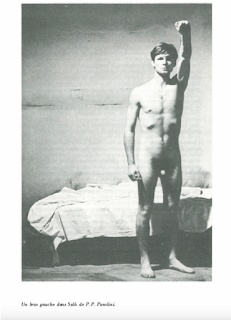
It is not because Saló is the last film of Pasolini that you are forced to see it as a “testament” (or a letter bomb, to open only with precaution: “No one indeed, it seems, can recover,” said Roland Barthes about this film). It is much easier to see the reconstruction of what could be, in a comparable context (Italian fascism) and a similar setting (Saló), the final attempt of masters in perdition to enjoy their power. 

First published in Cahiers du Cinéma, No 268-269, July-August 1976. Reprinted in La Rampe, cahier critique 1972-1982, Cahiers du cinéma – Gallimard, 1983. The illustration is from the original edition of La Rampe. The caption reads: "A left arm in Saló by P. P. Pasolini"

The State - Syberberg

Astonishingly, it is still possible to uncover new translations of Serge Daney online. The 2018 issue of the Hyperion journal, published by Contra Mundum Press, has three translations by Serge Daney. I will post the entries separately. 

The State - Syberberg (“Hitler, a film from Germany”) 

Hyperion, On the Future of Aesthetics, Vol XI, No 1, Summer 2018. Translation by  Rainer J. Hanshe. [link to pdf file].

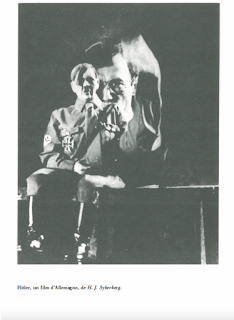
1. It isn’t very difficult to imagine the film that Syberberg would have made if he had wanted to reassure the critics. He would have justified himself in advance for his choice by highlighting the harsh necessity that we have — more than ever — to analyze and understand “the still fertile belly from which arose the foul beast.” He would have invited the spectator to a denunciation, a demystification, a de-something. The film would not have lasted seven hours, which is too long for a lesson, too long even for a show...

First published in Cahiers du Cinéma, issue 292, September 1978. Reprinted in La Rampe, cahier critique 1972-1982, Cahiers du cinéma – Gallimard, 1983. The illustration is from the original edition of La Rampe.

Saturday, March 05, 2022

Serge Daney's bibliography

The written work of Serge Daney consists almost exclusively of short texts published for the most part in Cahiers du cinéma and in the daily newspaper Libération as well as in some other magazines and books.

Daney published four books in his own lifetime, all collections of articles. He was working on a book project at the time of his death in 1992 (later published under the title Persévérance) and he is also believed to be the author of a little-known book, Procès à Baby Doc, Duvalier père et fils, a 1973 polemic text against the Duvalier regime in Haiti, written under the pseudonym Raymond Sapène.

The rest of his written work has been published posthumously in French:

  • Persévérance, Daney's big legacy project of a cine-biography of which he only managed to write the first chapter (The Tracking Shot in Kapo). The rest ended up as the transcript of a long interview recorded by Serge Toubiana. This book has been translated and published in English as Postcards from the cinema.
  • L'amateur de tennis, a collection of his sport articles on tennis matches written for Libération.
  • L'exercise a été profitable, Monsieur., a collection of notes he kept in his computer.
  • La maison cinéma et le monde, a four-volume anthology of texts not previously published, covering nearly everything from his first articles in a high school film magazine to his late years interviews. The first volume is due to be published in English in 2022 as The Cinema House and the World.

Over the years, many texts have been translated, including from Daney's own four books. But because they are scattered around the internet, it's not easy to understand how much of each book is actually available. So here are links to the table of contents of each book, with links to all the translated articles.


La rampe. Cahier critique 1970-1982

A selection of his writings for Cahiers from 1970 to 1982, published in 1983.


Published in 1986, the book contains all kind of articles (film reviews, festival coverage, analysis of TV broadcasts, etc) written for Libération which Daney joined full time after leaving Cahiers du cinéma in 1981. 


Published in 1988, it captures nearly all the texts of an eponymous chronicle about television that Daney wrote in Libération between September and December 1987.


A three-part book containing articles written in the last years of his life, from 1988 to 1991. Published in 1991 (one year before Daney's death).


Saturday, February 26, 2022

Samuel Fuller, Bad reputation

Third and final text of the series on Samuel Fuller translated with Andy Rector: a short text by Daney published in 1982.

Samuel Fuller, Bad reputation

Take Sadoul’s excellent little Filmmakers Dictionary (Dictionnaire des cinéastes, Editions du Seuil). Open the last edition to page 112 and read the article on Samuel Fuller. You will first find ten lines written by the late Sadoul himself: “dyed-in-the-wool anti-communism”, “racist themes”, in short: hate. After a paragraph break, comes thirty-seven lines full of praise written in 1981 by Breton and Marie. It’s a different vocabulary: “fanatical individualism”, “narrator instinct”, “in the tradition of Griffith”. Nobody says bad things about Fuller anymore, not even communists. Post mortem, Sadoul’s dictionary goes to Canossa and changes its mind on Fuller (and acknowledges it). Recently in 1982, the French Cinematheque organised a tribute to Fuller and on the day of the inauguration, Sam and his cigar came to exchange a few friendly words with a moved audience. It was the world premiere of White Dog. Fuller has not forgotten that his career as an auteur started in France. A strange career for a strange auteur. 

In the U.S.A., Fuller faced the problem of being an auteur in an anti-auteur system. Of being singular where ordinary individualism prevails. Of being a born narrator, evil-thinking and often inspired. Of being obsessed with two or three questions as old as Griffith and American cinema. I quote: the immediate transfer of History into stories, the live transplantation of documentary onto fiction, the art of the rapid catharsis, the “theme of the hero and the traitor” (with a predilection for the traitor), the archaeology of the American nation (and therefore racism). So, it’s in France that Fuller’s small frenetic films, often B series, were noticed. 

In France, Fuller faced the problem of being reduced to the anti-Communist content of his scripts at a time when the Cold War had dulled even the film critics’ wits. Sadoul got it wrong again and Fuller became an ideal target for those who thought themselves, self-righteously, on the Left. Anti-communist, therefore fascist and racist: nothing was spared. Sensitive cinephiles could see that this unclassifiable filmmaker who was very naturally making a very inventive cinema, converting the constraints of small budgets in creative licence, and only telling his stories, was the opposite of an ideologist. Divided, they concluded that the “form” of Fuller’s art was brilliant but that its “content” was very reprehensible. Pathetic.

One can be very American (and Fuller certainly is) by spinelessly celebrating the values of White America: puritanism and familialism. Some are even “WASPophile”. Never Fuller. He asked himself, more bluntly, from which crimes American came, and why this territory was populated by survivors: Indians, Blacks, Asians, Jews, and why it inherits from all the genocides. Fuller is a mythologist, a precious dismantler of the melting pot, someone always looking at the zero point in a story. This is why he is ahead of everyone in the critical thinking of modern westerns. His wonderful Run of the Arrow (1957) comes a good thirteen years before Little Big Man (and it’s a whole lot better). 

The paradox of Fuller, a journalist, traveller, writer of pulp novels and war stories, always news-hungry, is to have arrived ten or fifteen years too early in the landscape of American cinema. If he hadn’t demonstrated some very “Fullerian” vitality and optimism, he wouldn’t have found the strength to be present when, finally taken seriously, he was able to take up the thread of his broken career again and give us first The Big Red One and then White Dog. Especially White Dog

First published in Libération on 9 July 1982. Reprinted in La maison cinema et le monde, vol.2, P.O.L., 2022. Translated with the help of Andy Rector. 

White Dog, Samuel Fuller

Second text on Samuel Fuller translated in collaboration with Andy Rector. My personal favourite.


White Dog, Samuel Fuller

It’s the story of a racist dog. A good opportunity to revisit Fuller and what he talks about: precisely racism.

The study of racism is not more racist than knowledge of sugar is sweet. Yet, Fuller has always been suspected of being “contaminated” by his topic of predilection: the stupidity of racist delirium. Today, we tend to clear him of that view entirely. Fuller, racist? Of course not, we say shrugging our shoulders, exasperated. We are right to shrug our shoulders, but not to be exasperated. When a filmmaker doesn’t content himself with anti-racist discourse but looks deeper into the question and, acting like the old anarchist mole that he is, creates fiction, philosophy and cinema from it, one has the right to take what he says seriously. 

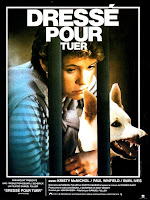
White Dog (which I can’t bring myself to call by its French title: Dressé pour tuer [Raised to Kill]) is not only his most beautiful film in a long time, but also a sort of pure sketch. A rundown of the question. And an overwhelming rundown, making current American film production appear empty and fussy by comparison. In White Dog, the action film and the philosophical fable progress together. What is physical is never not allowed to become intellectual, and vice versa. By dint of didacticism. 

I am not telling the story of the film. I am laying out its initial equation. It is necessary. A white man conditions a puppy to attack black people. The white man is racist, the dog becomes so. It sees the human species divided into two colours and becomes a “white dog”. One night in Hollywood, the lost dog is hit by the car of a young actress. Julie takes in the dog, saves it from extermination (the pound), heals it. The dog loves the actress and it’s his turn to save her, from a rapist. And then, one day, drama: we discover that the dog is a “white dog”.

A black anthropologist-trainer-maverick works in a sort of mobile zoo for Hollywood. Significantly, he is called Keys. He has made the deconditioning of white dogs his business. What threatens him as a black person has become his passion as a researcher. He needs a “white dog”. “This dog is the only weapon we have to destroy racism in the world”. Guinea pig, stake in the experiment, subject of the cure, bag of symptoms, the dog becomes all this. It all happens in the gaze. Keys, the black man, manages to decondition it, with ninety-eight percent success. 

For Fuller – all his films vouch for this – racism is a matter of education. Nobody is (or was born) racist. Many become so. Fuller doesn’t believe in natural violence, he knows it is nurtured. Since he is a violent filmmaker, he was always considered instinctual. This is an error. Violence in Fuller’s films (and this is why he is modern) is what exists between beings, the consequence of mimesis, the space between bodies, the space of news and media. Paradoxically, this “dyed-in-the-wool anti-communist” has an almost Pavlovian, “mechanistic Marxist” conception of racism. If all evil (or good) comes from education, it must be possible to re-educate. 

Fuller is not left-wing, but an old anarchist who believes in the primary innocence of beings. Outside: mimetic violence, inside: definitive childhood. Angels, children, beasts: men. Another danger: there is only a small step from innocence to purity (and we know that racism is a delirium based on purity). The line is thin, but Fuller has never crossed it. 

Sam Fuller loves victims, there lies his ambiguity. Including victims of racism. The scene is sublime when the real owner of the dog shows up with his two little girls and a box of chocolates. This pig is a kind old man. Sublime the way Julie doesn’t say anything to him (she insults him) but talks to the terrified little girls: “Don’t listen to him, don’t believe a word of what your grandfather told you!” Fuller is clearly in the same line as Griffith, some place in the scenario of the “massacre of the innocents”. 

How to overcome racism? How far do Fuller’s illusions go? White Dog seems to journey toward a happy ending, with the thesis of deconditioning seemingly satisfying everyone (even though it is worrying and suspicious: haven’t we seen recently the “de-conditioning professionals” of the Moon cult?). Keys achieves ninety-eight percent success. The final test: to unleash the dog (in a kind of arena) in the presence of Julie, Keys and his associate, Carruthers, a big, friendly (and white) man. I will not say what happens. 

Fuller doesn’t believe in deconditioning any more than a psycho-analyst believes in curing in a matter of days. The script is good but lacks time. Even cured, the dog is not cured of its violence, but of the racist dimension of it. It must learn not proceed through generalisations, and the only way to manage this is to teach it the “singular” aspect of each human being. One by one. And when it comes to capturing the singularity of beings, there is no one like Fuller, a fervent individualist. The dog has learned to love Julie who saved it, and then Keys who “tamed” it. The dog loves two beings in the world = the world is reduced to two beings. There remains the others, the much larger group – of white and black persons – that it doesn’t know, that it no longer knows. The dog will not manage to accede to the concept of “the human species”. It has switched from a bad generalisation (racism) to the inability to generalise. Its violence is no longer automatic and cold, it is transformed into a violence of love, which only knows those who love it. Who ever thought that love isn’t also a form of violence? No one. Not Fuller anyway. This is why the film is overwhelming. This is why the dog must be put down. For Fuller there is, side by side, an unabated optimism (he believes in good education, in science) and a modest certitude: the violence of love is already superior to the violence of racism. Love is a form of progress over self-hatred. But it too can kill. 

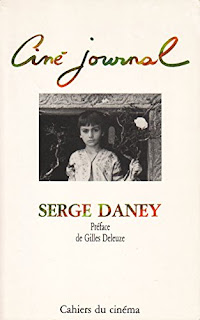
First published in Libération on 9 July 1982. Reprinted in Ciné journal 1982-1986, Cahiers du cinéma, 1986. Translation by Andy Rector and Laurent Kretzschmar.

The Fury of Storytelling - The Big Red One

First of three texts on Samuel Fuller. These translations were done in collaboration with Andy Rector with a view to create a bigger "Fuller Special" at Kino Slang which unfortunately got held up. It's also another text from La Rampe (Daney's first book). 

The Fury of Storytelling - The Big Red One (Samuel Fuller)

One day, maybe, we will see The Big Red One. Not the truncated version bearing this title that represented the U.S.A. at the Cannes Festival, but the four-hour saga that is, if not Samuel Fuller’s best film, his most ambitious project. The film that we are seeing today, thirty-five years after its auteur conceived it (“before Cahiers even existed” he says himself jokingly), is but a portion of the film that Fuller just shot. So, it’s a double discrepancy.  

Audience at zero

If his films were loved by a section of French film critics in the 1950s, if Fuller was endorsed by the Cahiers as a modern filmmaker, it is because he was, more than any other American (except Welles), obsessed with the contemporary. Even when he was narrating past events, he always knew how to create this impression of “for the first time”, of the cinema at its beginnings. As if, before him, no one had ever filmed, nor seen any films. On the one hand, Fuller was interested in the secrets and paradoxes of History (his heroes are always impostors: a fake baron, a fake gangster, a fake Sioux, a fake madman). On the other, his stories always had a founding dimension. His first film, I Shot Jessie James, stages a man destined to act out again, for the theatre, events that he had been the hero of. Also, at the end of Run of the Arrow, this statement to the audience: “the end of this story can only be written by you.” Fuller, both a war reporter and obsessed educator, starts with this idea that the audience knows nothing, or almost nothing. Telling in a few words who the Baron of Arizona, Sergeant O’Meara, the Werwolf, or Hitler is, Fuller never builds on the supposed existing knowledge of the audience. He considers the audience to be, like him, self-taught and in a hurry. So much so that educated and self-righteous audiences, offended to be deemed more ignorant than they are, have always hated Fuller’s films, finding them basic or simplistic, and covered them with insults. What is disturbing with Fuller (or, for others, what is stunning and convincing) are less his ideological convictions (clearly, Fuller is not left-wing, loves his country and hates communists) than this concoction between news and fiction. News: everything that has a name (Fuller is obsessed with proper nouns); fiction: everything that is wearing a mask (nothing excites him more than double-dealings). 

This concoction is not an ellipsis, that elegant way of gaining time. It is something else. Again, in Run of the Arrow, how to quickly show that the Civil War just ended? One could show the front page of a newspaper, or a distressed extra announcing the news, but Fuller is not interested in this type of speed. What interests him is to film Lee’s surrender, played by an extra, walking quickly, without grandiloquence, toward another extra. The historical event in itself, but as an insert. 

This is the modernity of Fuller: the vertigo of the contemporary and the temporary lack of perspective on things. In a small, tiny-budget but admirable and prophetic film (Verboten!) he joins the Rossellini of Germany, Year Zero, and we still think of Rossellini when seeing The Big Red One. The soldiers and the audience discover at the same time the war, and much more than the war: the landscapes and the populations that serve as background to the war. We think of Godard too, except that Godard’s passion for denotation (calling a cat a cat) always threatens to prevail over the desire for storytelling. It is the exact opposite with Fuller: storytelling will prevail over everything else, will distort and divert everything. J.-L.G. narrates very little; S.F. narrates too much. One slows down, the other forges ahead. But the result is the same: they both become marginal, dangerous, and unsavoury filmmakers. 

Impossible not to tell a story

So there was an “auteur” Fuller, an independent that the Hollywood machine ended up rejecting, a “European” Fuller if you will. And there was also an “American” Fuller, super-American even, less because of his political ideas than for his ability to heat up to the point of incandescence a fundamental aspect of American cinema: the impossibility not to transform everything into a story. Into a founding story moreover, a founding of the American identity. Fuller is devoted to fiction like others are devoted to drugs: beyond any taboo, any decency. He is “hooked” on fiction. 

This fury was freely unleashed in the B movies of the 1950s. Paradoxically and against all expectations, it is this fury which prevented Fuller, who was ahead of everyone else, from reaping the benefits of the fires he had contributed so vigorously to starting. He lacked the taste for comfort, the art of arranging a “good place” for his audience in order to unify it against something (that’s what Penn, Peckinpah, or Pollack will know how to do); he wasn’t ideological enough. It is a paradox because ideology (ready-made speeches, idiotic propaganda, doublespeak and clichés) is his very topic, his preferred subject. This is another common point with Godard: he is both interested and horrified by political-speak. His films are pyrotechnical machines that stem from the tongue and set fire to speeches. 

A necessarily ambiguous fire. During the Second World War, the journalist Fuller and the educator Fuller become one: he writes novels that soldiers read at the front, he must speak with the words of the tribe. War for him is perhaps just the extreme experience of the richness of sensations and the insufficiency of language. And to feel “in the present” one must speak with the words of everybody, the words of the GIs, the words of the media, while at the same time experiencing in a barbaric and refined way the inadequacy of these words with what is really happening. To question these words or to put them in quotation marks may raise the level of debate and intelligence, but it is a loss to the vertigo of feeling in the present, meaning to live. Fuller’s films start from what seems stable, fixed, erect and in costume, so a typical American worldview (a spontaneously racist worldview), and destroy along their way any sense of belonging or identity. More through an excess of fiction than out of critical distance. I don’t believe that the great Americans (Griffith or Welles) proceeded in any other way: never by putting quotation marks on the words of the tribe but rather through malfunction, excess or waste. 

As for Fuller, he will go to the end of the idea of catharsis which is the necessary consequence of this fury of storytelling. Catharsis allows one to live with what shouldn’t be (seen) repeated. It has nothing to do with the “work of mourning”, this suspicion that between fiction and document, dream and proof, one must invent new distances and new rituals. Modern cinema, which was built from the work of mourning (Syberberg, Godard), has been European. But not American cinema which is always forging ahead toward catharsis (The Deer Hunter). In-between the two, Fuller is the only one who dared, twenty years before Holocaust, to bring together in the same film (Verboten!) these two types of images: stock-shots from the Nuremberg trials and images from his own B movie. 

The danse macabre as film form

The Big Red One is therefore, in its current form, a traditional war film, superbly filmed, precise and dry: a film “like they don’t make anymore”. But what we can guess about the original project leads us to imagine a wider, disproportionate film: the crossing of the entire Second World War, seen through the successive missions of a regiment, of a squad of four men plus one, “the Sergeant”, played by Lee Marvin, devoid of any expression. These four indestructible characters cross countries they don’t know (Algeria, Sicily, France, Belgium, Czechoslovakia, and finally Germany), meet other soldiers, friends or foes, collaborators or resistance fighters, and in the end, it still comes down to them to free, open and discover the death camps. 

Fuller’s traditional idea of the war is that it can be reduced to a single question: to kill or to be killed. The rest would be mere intellectual chit chat. An idea as irrefutable as it is shortsighted. Yes, his films have always revolved around the question of identification (to another, to an ideal, to the ideal other) and the aberrations of the eternal “I love you, I kill you”. Fuller’s heroes’ double-dealings are protecting them from the horror of an encounter with a double (like William Wilson) which could lead to their death. They are already double. But the war is the moment when, despite everything, this encounter is very possible indeed, when one constantly risks crossing the gaze of the other, of this enemy that is an enemy only by game and by name*. With Fuller, one of the most violent filmmakers, violence is always mimetic. It is the violence of the masks that no longer hold (his entire body of films mirrors the prodigious opening scene of The Naked Kiss: during a fight, a woman loses her wig – she is bald). It is the violence of the ideologies that don’t hold up much better (in the sense that, according to Zinoviev’s strong expression, ideology is something that one “adopts”, as a sort of voluntary mask).

How to end?

The big difference between life and cinema is that at the end of a film, a small bit of writing, the words THE END, strike through an image. This is the truth of the relation between image and writing. Following the itinerary of the Sergeant, Fuller asks himself under which conditions there could be an end to wars. The answer is literal, tinged with dark humour: there wouldn’t be any more wars if only one war could truly end. But it only takes one soldier, somewhere, to ignore the armistice just signed (this is the story of the hero of Run of the Arrow or of these Japanese soldiers still “holding on” to some Pacific islands) to create a fatality of the return of wars. Just one more bullet and the fury of storytelling starts again. It happens twice to the “Sergeant”, in 1918 and in 1945. Fuller’s obsession – the typical obsession symptom –, is the bullet shot one second too late and the war hero turned into a common law murderer. But how can one know that the “war is over”?

The Big Red One, Fuller’s magnum opus, is haunted with the desire to end, to write the words “the end” for good.  Hence the final happy ending, moving because improbable. “To kill or to be killed”, this warrant officer’s wisdom, is a false choice. In one way, the one that kills dies too, he commits suicide. He becomes Death itself, which ignores the double game. The double game is what saves mimetic violence: only impostors are alive. Otherwise, underneath the features of the four soldiers of the film, too beautiful and too vulnerable, one must see the face of the Four Horsemen of the Apocalypse. To join in the camp of the survivors, to have killed the other inside oneself, is to be truly dead.

* In the French text: que par jeu (que par double je). Literally: "only by game (only by double "I").

Translators' note: while translating the text with Andy, we toyed with the idea of keeping some French word references in the English text. I've removed them in the final version to preserve fluidity. But, in the spirit of disclosure (and to show the impossible compromises we had to make), we have used "storytelling" and "story" for récit, "contemporary" or "news" for actualité or informations, "concoction" for précipité and "double game" or "double-dealings" for double jeu

First published in Cahiers du cinéma, issue 311, May 1980. Reprinted in La Rampe, cahier critique 1972-1982, Cahiers du cinéma – Gallimard, 1983. Translation by Andy Rector and Laurent Kretzschmar.